
Heritage & Theology
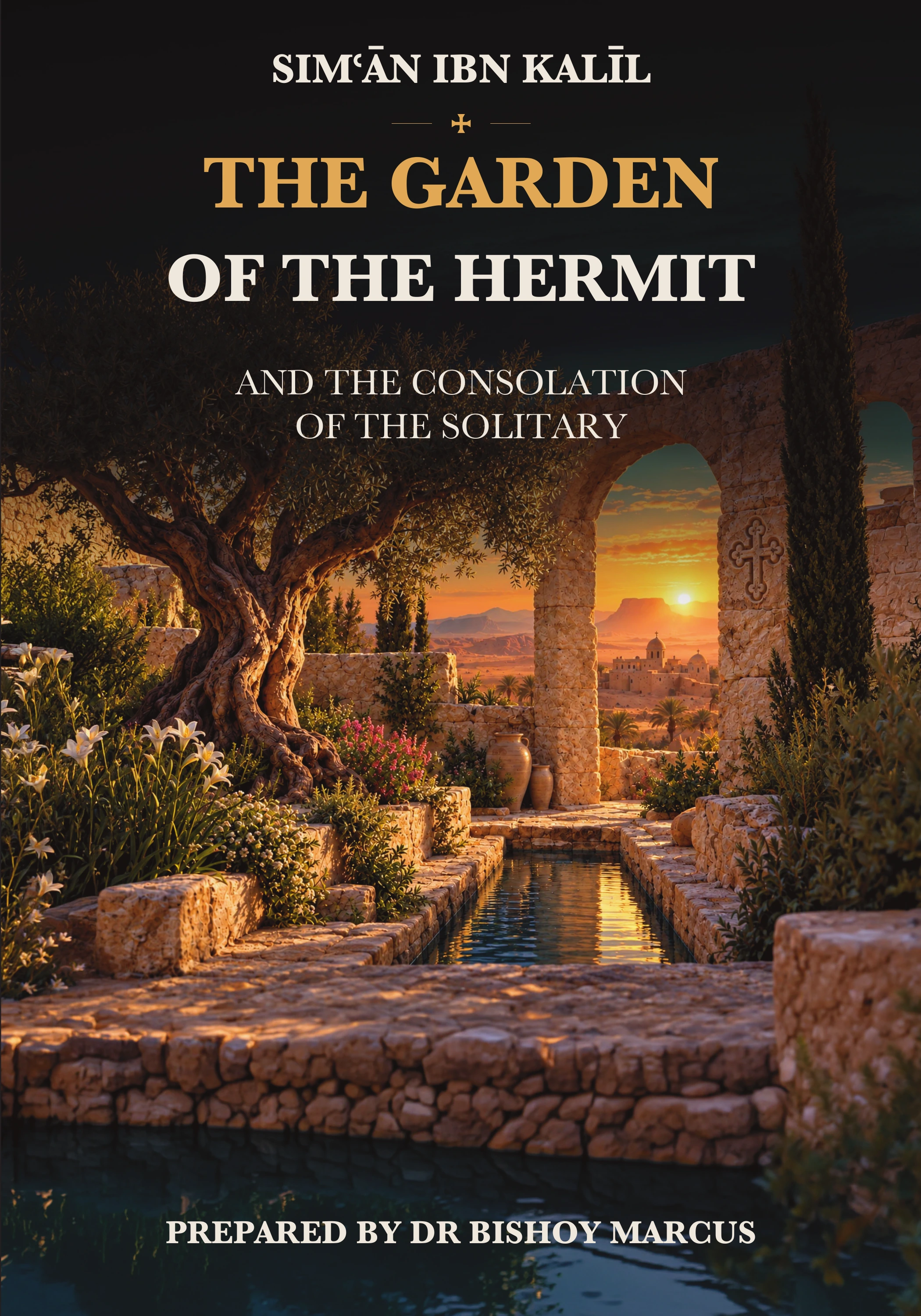
The Garden of the Hermit
Twelve Coptic Arabic discourses on prayer, patience, love, humility, forgiveness and the formation of the soul.
Coming soon
Edition details
Paperback
- Format
- Paperback
- Language
- English
- Pages
- 200
- ISBN-13
- 9781923901544
- ISBN status
- Reserved; registration pending
- Dimensions
- 7 × 10 in
- Availability
- Coming soon
Hardcover
- Format
- Hardcover
- Language
- English
- Pages
- 200
- ISBN-13
- 9781923901551
- ISBN status
- Reserved; registration pending
- Dimensions
- 7 × 10 in
- Availability
- Coming soon
Discover the book
About This Book
Simʿān ibn Kalīl’s The Garden of the Hermit and the Consolation of the Solitary speaks from the desert about the formation of the rational soul. Its opening asks why human beings were created, what purpose belongs to a reasoning creature and how faith in the one eternal God orders the whole of life. The work is moral instruction, but it begins with creation, worship and the dignity of the person.
Across twelve discourses, the author follows the practices by which desire is trained: reverence for God, continual prayer, fasting, patience, love, chastity, humility, forgiveness, contentment and justice. He considers how appetite, anger, careless speech, resentment, possessions and pride can turn the heart away from its true good. The answer is not a list of abstract ideals, but a disciplined pattern of conduct.
The desert voice is attentive to hardship. Patience is described as a root of courage and a foundation for worship; humility steadies the person who is insulted; forgiveness loosens the grip of revenge; love changes how one treats both friend and enemy. Biblical and patristic sayings are woven through the arguments, while the author repeatedly returns to self-examination and the training of habit.
For readers interested in Coptic Arabic spiritual literature, monastic counsel or the practical shape of a virtuous life, this book offers a sustained encounter with a monastic moral imagination. Its garden is not an escape from struggle. It is a place where the solitary heart learns to practise wisdom, restraint, courage, mercy and a steadier love.
Simʿān ibn Kalīl was an Egyptian Coptic monk associated with the Monastery of Saint John the Short in Scetis. This English edition follows the 1872 Cairo Arabic printing; selected difficult passages were also checked against the 1886 printing. It is not a critical edition of the manuscripts.
Twelve Coptic Arabic discourses on prayer, patience, love, humility, forgiveness and the formation of the soul.
Generative artificial intelligence assisted the English translation and preparation of this edition. This accessible edition does not replace primary texts, printed editions or surviving manuscripts. Scholars should verify quotations, textual readings and academic conclusions against those sources.
Inside the book
Look Inside
The twelve selected pages are from the 200-page 7 × 10 in paperback preparation.
An access edition
Read, explore, contribute.
This edition is intended to improve access to the work. Advanced digital tools, including generative AI, were used in its production, with responsibility for the final text and editorial decisions remaining with the editor.
This access edition is intended for general reading, discovery and further exploration. It may also serve as a stepping stone for academic study. Some passages may remain uncertain or benefit from further refinement. Readers undertaking academic research or detailed theological study should consult the original-language sources, relevant manuscripts and specialist scholarship; this edition is not presented as a scholarly translation or critical edition.
Source and edition details: Consult the source and edition notes in your copy. A verified bibliographic record has not yet been added to this website.
For corrections, please give the edition or version printed in your copy, or state that it is not identified.
We welcome suggested corrections, alternative readings and supporting evidence. Accepted changes are published in a dated record and incorporated into subsequent editions, with acknowledgement by permission.